Français
 Română
 Home
Home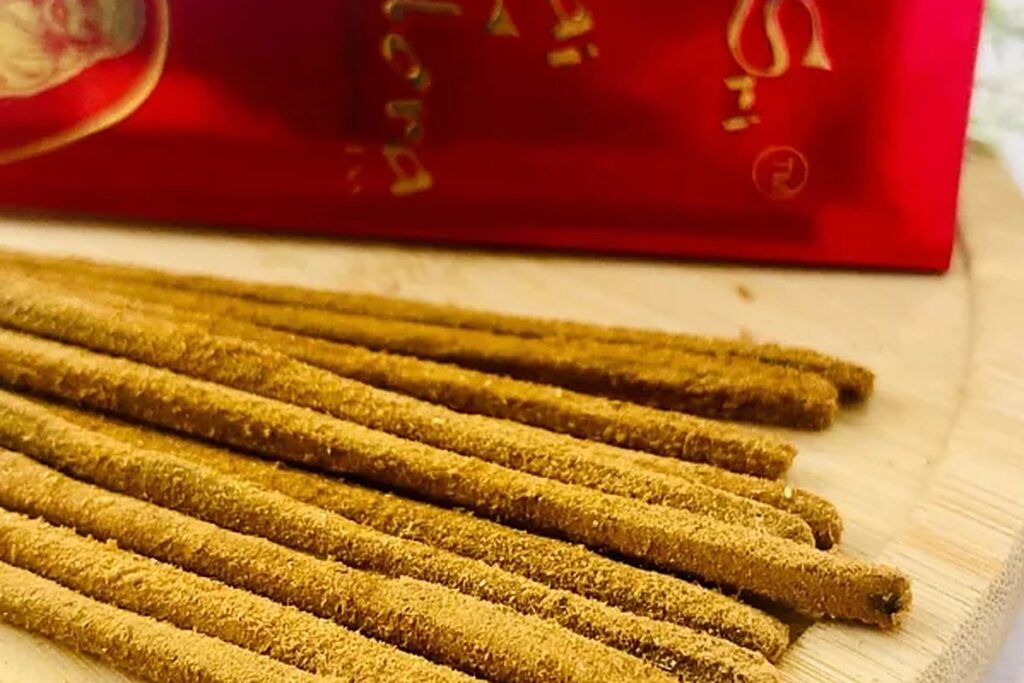
Do you know which incense is the most used in Indian homes? Not Nag Champa, not sandalwood, but one that is pungent, floral and resinous—sometimes smoky, always unmistakably strong. You’re right: Sai Flora.
Many people in the West don’t understand it. Some can’t stand it. But in India it’s everywhere, and perhaps for a surprisingly simple reason. Physics.
I wondered for years what Indians find in it. It’s inexpensive, powerful, and built on an unusual blend of heavy resins and gums with vetiver, patchouli, jasmine, sandalwood and various florals—one perfumer once told me a good Sai Flora carries forty different ingredients. Light one and it fills an apartment in minutes. No matter the size of the room, you smell it through the whole building and out into the street. It seems made for the local climate, and over the years it has become one of the most widely used incenses in Indian homes.
I’m telling you this because I think I finally understood why it works there—and why so many people love it.
A heatwave, and a sandalwood that vanished
The end of June 2026 was brutal in Europe. Temperatures climbed towards +40°C across much of the continent, and France was hit especially hard. France isn’t built for this—strict local rules make it difficult to fit air-conditioning to many apartment buildings because an outdoor unit spoils the façade and simply isn’t allowed. So we endured it.
At around +38°C I lit a new sandalwood stick we’d just sourced from Karnataka, intending to write its description and begin the packaging. Ten minutes in, the scent wasn’t carrying. It felt thin, watered down, gone almost as soon as it appeared. That surprised me—this particular factory never skimps on sandalwood oil. I burned the whole stick and it stayed strangely light, as though all the fresh opening had simply slipped away.
So I lit a Nag Champa, rich in halmaddi resin, exactly the kind of incense that normally lingers. The same thing happened. The creamy florals appeared, then seemed to dissolve into the hot air.
For a moment I wondered whether I’d lost my sense of smell.
Then I started reading about how scent behaves in high temperatures, and realised the problem wasn’t my nose.
It was the air.
What’s really going on
The old intuition is that heavy oils stay while light ones escape.
Oddly enough, that’s both right and wrong.
It’s tempting to imagine light fragrance molecules floating up to the ceiling while heavier ones settle around us, sorted by weight. That’s not what happens. Once scent molecules enter the air they collide with billions of air molecules every second. They mix rapidly and travel wherever the air itself moves. Gravity plays almost no practical role inside a room.
The real answer is volatility: how readily a material evaporates into the air.
Top notes are highly volatile. Heat gives their molecules more energy, so they evaporate more quickly and reach their peak concentration sooner. On a very hot day they seem to disappear almost as quickly as they arrive, not because they’re destroyed, but because they’re released, diluted and dispersed through the room much faster than we’re used to.
Resins, balsams, patchouli, vetiver and other classic base materials behave differently. They evaporate far more slowly and continue releasing aromatic molecules throughout the burn. Instead of giving one brief burst, they feed the air continuously, so their presence remains noticeable long after the lighter notes have faded.
That’s really what the perfumer’s note pyramid describes. Top, heart and base notes are, to a large extent, fast, medium and slow rates of evaporation. Heavier molecules often happen to be less volatile, which is why the old instinct that “heavy oils last longer” isn’t entirely wrong—it simply isn’t gravity doing the work.
The smoke itself plays an important role too.
The glowing tip heats the surrounding air. Warm air becomes less dense and rises, carrying with it smoke particles and freshly released aromatic molecules. When that air reaches the ceiling it spreads, cools and slowly sinks again, creating a gentle convection loop—a natural little fan that quietly circulates fragrance around the room.
But incense adds another layer of complexity that perfume never does.
A perfume simply evaporates.
Incense is constantly being transformed by heat.
Just behind the glowing ember is a warm zone where essential oils gently evaporate much as they would from a perfume blotter. Closer to the ember the temperature rises dramatically. There, woods, resins and essential oils begin to break down in a process called pyrolysis. Some original aroma molecules survive unchanged, some are altered, and entirely new aromatic compounds are created.
That’s why a burning sandalwood stick never smells exactly like an unlit one. You’re smelling not only the original sandalwood oil, but also new fragrance molecules born from heat itself.
The warm air carries the fragrance around the room.
Volatility determines how quickly different materials enter the air.
Pyrolysis quietly rewrites part of the fragrance as the stick burns.
Together they create the living scent of incense.
During a heatwave, the delicate opening of a fine sandalwood can pass by remarkably quickly, while something like Sai Flora—built around generous amounts of slow, resinous materials with patchouli, vetiver, jasmine and gums—keeps feeding the air steadily throughout the burn. Its character remains full even after the brighter notes have softened.
Ironically, Sai Flora can feel even richer on cool evenings, when its lighter floral notes have more time to unfold before the deeper materials take over.
India may have solved this long ago
This is the part I enjoy most.
Indian perfumery didn’t necessarily arrive at these heavy, persistent materials by understanding vapour pressure or molecular diffusion. It arrived there through centuries of observation.
Summer in northern India is the season of khus. Vetiver root screens—khus tatti—are hung across windows and splashed with water; as the water evaporates it cools the air while releasing that unmistakable earthy fragrance. There’s khus sharbat to drink, khus attar to wear, and vetiver woven deeply into daily life. Long before modern chemistry explained why certain materials perform so well in heat, people already knew which fragrances remained satisfying through the hottest months.
It’s tempting to think the perfumers who created Sai Flora followed exactly the same intuition. They probably never spoke of volatility or vapour pressure. They simply knew that resins, gums, patchouli, vetiver and rich florals continued to smell beautiful when lighter fragrances seemed to disappear.
Halmaddi deserves a mention too. This soft resin, so characteristic of traditional Nag Champa, does more than contribute its own creamy aroma. It helps bind essential oils within the incense, slowing their release and giving the fragrance a softer, more gradual evolution throughout the burn. It’s one reason a good halmaddi-rich incense often feels rounder and longer-lasting than a drier composition built mainly around volatile oils.
Humidity changes the experience as well.
It’s often said that humid air “carries scent better”. The reality is a little more subtle. Humidity affects how quickly some aroma molecules evaporate and also how comfortably our nose perceives them. When the air isn’t excessively dry, fragrances often feel fuller, smoother and easier to appreciate—which may explain why incense can seem especially beautiful on a warm, rainy evening.
What to burn when it’s hot
If there’s one practical lesson from all this, it’s simple.
- Go heavy. Resinous blends, patchouli, vetiver, ambers, balsams and rich florals tend to hold their character remarkably well in hot weather. This is their season.
- Save the delicate ones. Fine sandalwoods and lighter floral incenses are wonderful—but they often reveal far more nuance on cooler evenings, when their subtle opening has time to linger before fading into the background.
- Burn lower rather than higher. Place the incense lower in the room if possible and let the natural convection carry the fragrance upward. In a smaller room you’ll often notice more of the composition because the scent has less space to disperse before the circulating air brings it back to you.
So do we like Sai Flora in the West or not?
Maybe there’s a reason it never became a Western favourite. Its pungent, resinous palette can be overwhelming for European and North American noses that weren’t raised with that kind of intensity.
Then again, our summers keep getting hotter.
An incense designed—perhaps unintentionally—for tropical heat may begin to make more sense than it ever did.
Perhaps it’s time we gave it another chance.
At Bhagwan, we do not sell the classic Sai Flora incense. However, these two fragrances come from the same tradition: King of Flora and Queen of Flora. They are more refined, premium-quality Indian flora incense sticks made for the Western customers, crafted in the same classic floral style while offering a richer, more sophisticated fragrance.
Try them today and discover how well they perform, even in extreme heat!
Happy burning,
Eugene